Anti Sacrilege Law: Sacred or State-Controlled? The politics behind Punjab’s Anti-Sacrilege law....by Kiranjot Kaur, Senior SGPC Member / Grand Daughter of Master Tara Singh
The recently passed Jagat Jyot Sri Guru Granth Sahib Satkar (Amendment) Bill 2026 has raised concerns in a section of Sikhs. At the heart of it is a very fundamental question: should a Sikh’s very personal and spiritual relationship with Guru Granth Sahib be brought under a legal and administrative framework?
The roots of this moment can be traced back to the Bargari sacrilege in 2015. It triggered widespread protests across the state. The Shiromani Akali Dal govt mishandled the situation, and the political fallout continues to shape electoral outcomes.
When the Aam Aadmi Party assumed power in 2022, it came with a promise of delivering justice in the Bargari sacrilege case of 2015.
Kunwar Vijay Partap Singh, who investigated the police firing on peaceful protestors in Kotkapura and Behbal Kalan, was included in the party and given a ticket as a sign of their honest intent.
However, on assuming power with a brute majority, the promises did not translate into concrete outcomes. Investigations slowed down, the cases were shifted out of Panjab, and key allegations remained unaddressed. No effort was made to file an FIR against Dera Sauda Sadh, despite a witness going public on social media.
As Panjab moves closer to the upcoming Panjab Vidhan Sabha elections in 2027, the political narrative has shifted. Gurjeet Singh sitting atop a BSNL tower was the perfect choice for AAP to address public anger against unresolved sacrilege cases. The protestors demanded stricter legal provisions.
Responding to public sentiment, the Panjab government proposed a “Prevention of Offences against Holy Scripture(s) Bill 2025.” The Holy Scriptures included Guru Granth Sahib, Geeta, Quran, and the Bible. It met with resistance from Sikhs; the other Scriptures do not have the kind of status in their respective religions that Guru Granth Sahib has in Sikhi.
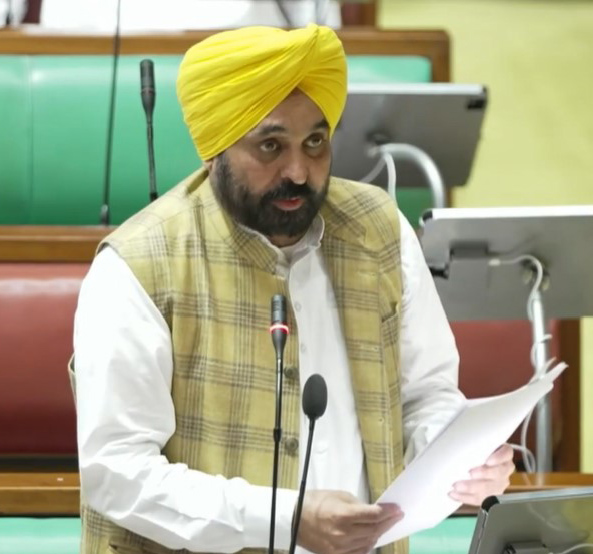
Also, demands from other deras and sects complicated the issue. CM Bhagwant Mann set up a meeting with Sant Samaj in Amritsar, where the Sant Samaj pointed out the unique status of the “Living Guru” of Guru Granth Sahib among other Holy Scriptures.
The proposed Bill 2025 was given a quiet burial in the name of extension. On April 13, 2026, CM Bhagwant Mann announced the alternative: the government would amend the existing Jagat Jyot Sri Guru Granth Sahib Satkar Act 2008.
This Act was only for the purpose of giving SGPC all rights to print, store, and distribute copies of Guru Granth Sahib. Now it has been expanded to include custody, protection, and offences.
The new Act transforms the Sikh religious code of conduct into a state-regulated domain.
The language and terminology used challenge Sikh doctrine. CM Mann introduced the Amendment Bill by replacing the word “Bir,” used for Guru Granth Sahib in the original 2008 Act, with the word “Saroop.”
He justified it by referring to the ‘doha’: “Guru Granth ji maneyo pargat guran ki deh,” sung in every gurdwara after Ardaas. This line is not meant to objectify the Bir but to set the tone for the Maryada to be followed. It does not exist in Guru Granth Sahib. In an exaggerated show of respect, the CM referred to Panne (pages) as “Ang” (body parts), another departure from Sikh vocabulary.
Traditionally, we refer to a copy of Guru Granth Sahib as “Bir”; Kartarpuri Bir and Damdami Bir are used for specific Birs. “Bir” means compiled and bound together. Guru Granth Sahib has bani of various Bhagats and other Gursikhs besides the Sikh Gurus in a Bir. Sikhs follow Guru Nanak Dev ji’s doctrine: “Sabad Guru, surt dhun chela.”
The Amendment Bill has introduced the concept of “custodian.” It refers to an individual, institution, or gurdwara to whom a Bir has been formally supplied and makes them legally responsible for its “protection” and observance of prescribed Sikh Rehat Maryada.
The custodian shall ensure “safe custody, protection from damage, misuse, or loss in any manner,” which raises concerns that individuals could become automatic suspects in cases of alleged sacrilege. Private homes may be subjected to scrutiny and intervention. Existing vigilantism would gain legal backing.
I am a witness to such incidents. A vigilante group raided a Sikh family’s home in Amritsar early in the morning and forcibly took away the Bir, alleging beadbi. The reason given………the family did not do Prakash at 4 am. Individual homes are not bound to do Prakash and Sukhasan at gurdwara timings.
On reporting the incident to the then ACP Amritsar, he justified the action of that Satkar Committee. The Satkar Committee claimed permission from the local non-Sikh SHO to enter the private residence.
The Bir was returned when SGPC wrote a complaint to the Police Commissioner Amritsar seeking suspension of the concerned SHO for encouraging trespassing into a private home. The new Act gives legal power to the SHO to check every place which has Prakash of Guru Granth Sahib.
In another case, the room of Guru Granth Sahib caught fire because of a short circuit in the AC. Before SGPC could reach the family, the local police called a Satkar Committee to look into the matter. They came in hordes, trying to bulldoze the young owner of the house into admitting he was responsible for “beadbi.”
They refused to see the situation, and their leader categorically said their agenda is to remove the Birs from individual homes. Under the new Act, the owner of the house and “custodian” of the Bir can be booked for such “beadbi.”
The Act includes “Guru Granth Sahib or part thereof.” Parts of Gurbani are in the shape of Gutka, Pothi, Sainchi, and books related to Sikh religion. It could criminalise natural wear and tear and accidental damage—for example, because of electrical faults, fire, etc.
Anyone who reads Paath from the Gutka regularly knows that over a period of time, the binding becomes loose and the pages break free. Paper of old Birs of Guru Granth Sahib gets fragile and brittle over time.
Sometimes it gets a bit torn; that will also be a crime under the new Act. Already, many Sikh families have given away their Birs because of this vigilantism. The new Act raises fear that ordinary religious practice could become legally risky. Many more families could move away.
The lightning speed with which the Governor of Panjab gave assent to the Bill raised eyebrows. It could be a competitive political positioning of the BJP. It suits the broader strategy of the BJP of assimilating Sikhs and reinterpreting their history to their political advantage.
Equally significant is the question of enforcement. Offences under this Act are non-bailable and non-compoundable, but no accountability of the law-enforcing agency has been outlined.
Under Section 6, “No suit, prosecution, or other legal proceedings shall lie against the State Government or its officers or officials in respect of anything,” thereby giving them a free hand. The possibility of the state interpreting and enforcing aspects of Sikh Rehat Maryada—traditionally a matter of religious guidance—has added to the unease.
Where will be the boundary between governance and faith?
While there is broad agreement on the need to address sacrilege seriously, strengthening Section 295A of the Indian Penal Code may have been a less intrusive alternative.
The silence of SGPC over this issue is deafening. The Act hands over power to the State Government to monitor printing, storage, and distribution of the Birs.
Every Bir’s location is to be put in the public domain, making custodians sitting ducks for harassment!
The question is: can the State protect religious sanctity without encroaching on religious autonomy? The answer to that question will define not just the future of this law, but the nature of state-religion relations in Panjab.
Last question: will it bring closure to the Bargari sacrilege? Certainly not.
April 25, 2026
Related News Links:
-

-
Kiranjot Kaur, SGPC Member
kksgpc@gmail.com
Disclaimer : The opinions expressed within this article are the personal opinions of the writer/author. The facts and opinions appearing in the article do not reflect the views of Babushahi.com or Tirchhi Nazar Media. Babushahi.com or Tirchhi Nazar Media does not assume any responsibility or liability for the same.