KMB-2025: Sujith’s painting -- when histories come alive and circle round.....by Sukant Deepak
Vibrant sunset hues—in shades of red, yellow, orange with crests of black—catch the eye and the wave-like motion beckons the viewers nearer as they walk into the room. Each step towards the large painting by Sujith SN offers new insights and plays with the vision.
The paintings exhibited as part of the ongoing Kochi-Muziris Biennale (KMB) at Space Gallery over a century old Indian Chamber of Commerce and Industry in Mattancherry, move from dream to reality, leading one to a kind of make-believe world.
The closer one goes, remnants of the past negotiate with memories, each layer dotted with images on the expansive landscape spurring the viewer’s curiosity to explore more, tracing forms of wells, ruins of homes, buildings, even a glittering sun, spelling hope.
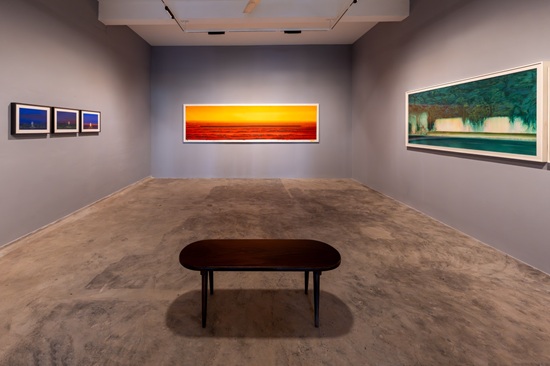
Each visual vies for attention. It looks like the layered crests mark many a sunset and sunrise from era to era, a narrative of histories written and rewritten, of wars, destruction, excavation, extraction, erasure, digging, burying, and re-excavations, raising questions of perspectives and interpretations at collective and individual levels.
In the centre, a black pit-like stretch appears like a pit to the underworld. The remnants remind one of excavations in Pattanam as well, linking Kochi’s history to Muziris and other such sites, or even the Wayanad calamity, war-torn lands, an encounter with bleak realities circling round endlessly. The deeper one looks, murkier are the revelations stretching far away to a barren expanse of saffron.
“My works are an exploration of my inner world and tend to deviate from a linear narration in a space that swings between the conscious and the unconscious,” said Sujith.
On the other walls, tempera on paper, diptychs and triptychs, in ominous shades of green, raise thoughts of rich, fertile plant and forest wealth of the land. “I have used arsenic green,” said Sujith.
The frame of rocks near a forest stream with people leads to another with just remains of rocks and dense forest bound by a white wall with steps leading inside, the wall continuing into the triptych with creepers overpowering it, creating an illusion of dam-like waterfall.
Titled ‘Gate to the Botanical Garden’, referring to a 17th century monumental botanical work Hortus Malabaricus (Garden of Malabar) in Latin, published in Holland, it is a peep into history when the then Dutch Malabar Governor Henrik van Rheede extracted the medicinal plant wealth of the land, in Kochi and realised their potential for trade and research.
It takes the viewers to a time when Rheede took three decades to get the plant wealth recorded with the help of Ezhava Vaidyan Itty Achudan (an ancient herbalist and botanist who belonged to an Ezhava family in Kerala), and a team of Dutch and Indian physicians, administrators, artists, and helpers.
On another wall, an eerie silence pervades a house hidden in a coconut grove and abstract forms emerging.
Another triptych shows a boat gliding on the water lined by paddy sheaths (could be the saline- resistant Pokkali) bowing ready for harvest. The greenery looks outlandish, the detailing of leaves reminding one of weathered laterite texture. The frames are foreboding, a reminder of vanishing forest wealth, laterite plunder, building of more walls where green walls once sufficed and when people revered nature and lived in harmony with it.
In yet another triptych, stretches of paddy fields, a part of the rich and diverse ecosystem of Kerala, speak of an agrarian society that once thrived as visual shifts to modern ways of farming that create an imbalance.
Each frame is layered with abstract narratives and a silence fills the air, a silence that disturbs when viewers go near. “Painting is not a picture, it’s an experience,” said Sujith, leaving it to viewers to interpret.
February 9, 2026
-

-
Sukant Deepak, Culture writer Co-founder: Elsewhere Foundation
sukant.deepak@gmail.com
Disclaimer : The opinions expressed within this article are the personal opinions of the writer/author. The facts and opinions appearing in the article do not reflect the views of Babushahi.com or Tirchhi Nazar Media. Babushahi.com or Tirchhi Nazar Media does not assume any responsibility or liability for the same.