Biennale artist Vinoja Tharmalingam recreates pangs of Sri Lankan Civil War at Kochi Biennale.....by Sukant Deepak
Broken, fragmented, distorted, displaced, and maimed—the series of bunker installations by Sri Lanka-based artist Vinoja Tharmalingam, titled ‘My
Last Breath with All My Burdens’ (2025), narrates the nightmares and struggles encountered in war-torn life in Mullaitivu, northern Sri Lanka.
She has recreated the dark and dreadful side of humankind, the trauma of makeshift life over nearly three decades of Sri Lankan Civil War along with her textile series, A Land Woven with the Threads of Memories (2025), in Island Warehouse, Willingdon Island, as part of Kochi-Muziris Biennale running through March 31.
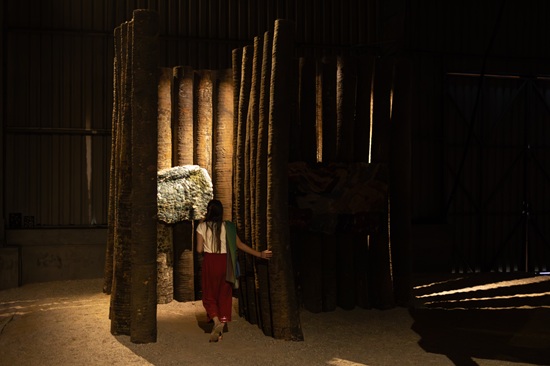
The artist’s installations are scarred with memories and the heaviness of history of Mullivaikkal genocide, as usual at the peace-making phase of war in 2009.
“Today, as demining is on, the remnants of torture, shelling, killing, bloodshed, which snatched nearly a lakh life in the massacre, wrecking, ruining, and disabling thousands, are etched in survivor’s minds. Life was literally a journey in darkness moving from one bunker to another; people hid whenever sounds were heard and stealthily came out to cook in the open. The beautiful coastal landscape bordering the Indian Ocean is akin to Kochi, fishing, forests, farming and lagoons,” Vinoja said.
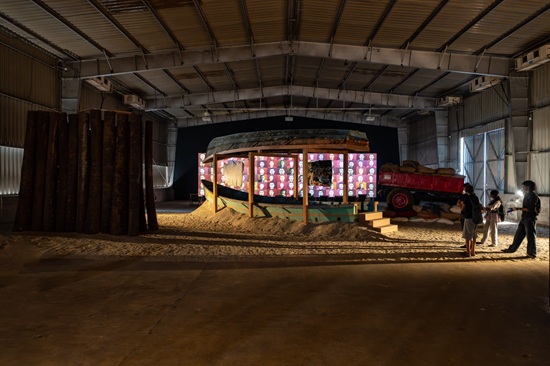
She has created a coastal landscape with sand-laden floor on which a tilted boat atop another serves as a bunker. People fish and sail in the boats but dig them into the soil to form bunkers when danger lurks. A little away is a tractor trolley stacked
with paddy sacks, grains popping out from some. The space dug out below screened by sand in hand-made bags and sacks and saris serves as a bunker.
“People pounded paddy and cooked the rice. They moved on in the tractor till fuel allowed them to. To get the essential needs was a struggle. Some of the weak, wounded and elderly died and were buried in the bunkers sans last rites as life was a journey from one bunker to another. The pangs of displacement and migration are felt everywhere,” said Vinoja who weaves stories through felting, weaving and embroidery.
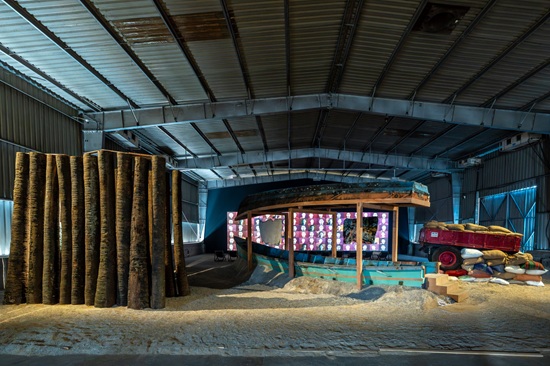
She picked up sewing from her mother as most women were into sewing and patch up work. Her third bunker comprises long palm stumps placed in rows to form walls of a roofless shelter that is dark and dreary. “Mullivaikkal is a beautiful place like Kerala with more Palmyra palms than coconut palms. Forests and trees were burnt and people made use of whatever material was available,” she said.
Tharmalingam has sourced the materials in Kochi which shares histories and culture with her homeland; of the Portuguese, Dutch and British exploitation; the divide and rule of post-colonial period paving way for differences and war.
Her textile art in the form of rugs adorns the palm stump walls narrating tales of forests, homes, hospitals, and schools crumbling on one side and people dying on the other. The beautiful places full of life, mirth and laughter turn into still and dead
zones. Layers of memories unfold.
“They are aerial mapping of the land. Hand-felting or Namda art is common rug- making practice in Pakistan and Kashmir, a form of matting, layering and fluffing cotton and wool fibres, but I have used bandages, human hair, fabric, rope and fibre to bring out the realities of war—loss, abduction, abandonment, threats, poisoned environs and life.
“It’s a second skin, a mute witness to the bleak realities in bunkers in Jaffna and refugee camps in India, a call against forgetting,” said Vinoja, for whom art is mapping of injustices, erasure, a call for harmony and non-violence, a kind of cleansing and healing.
March 27, 2026
-

-
Sukant Deepak, Culture writer Co-founder: Elsewhere Foundation
sukant.deepak@gmail.com
Disclaimer : The opinions expressed within this article are the personal opinions of the writer/author. The facts and opinions appearing in the article do not reflect the views of Babushahi.com or Tirchhi Nazar Media. Babushahi.com or Tirchhi Nazar Media does not assume any responsibility or liability for the same.