Punjab-based Sapta Sindhu Historian Harbhajan Singh Selbarah honoured by Haryana Govt
Harbhajan Singh Selbarah’s Contribution to the Historiography of Sapta Sindhu
Ravi Jakhu / Babushahi News Network
Panchkula-Chandigarh, September 17, 2026: Harbhajan Singh Selbarah was honoured by the Haryana Sahitya and Sanskriti Akademi, Panchkula, for his invaluable contribution to the history of the Sapta Sindhu region.
A one-day national symposium on his contribution was held at the Maharaja Dahirsen Auditorium of the Akademi building. The chief guest at the symposium was Dr. Kuldeep Chand Agnihotri, Executive Vice President of the Akademi. Historian Harbhajan Singh Selbarah presided over the event, while Mr. Manjit Singh, Member Secretary of the Akademi, was the special guest.
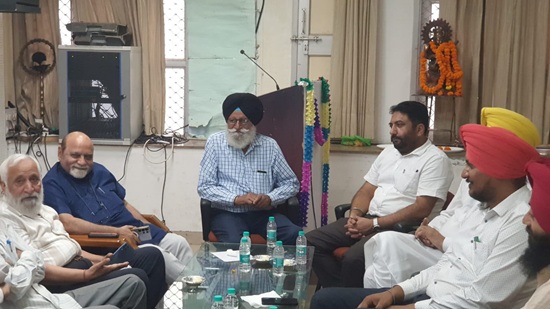
The speakers included Dr. Jagpal Singh, Assistant Professor at TPD Malwa College, and Dr. Jaswant Singh, Assistant Professor at Punjabi University, Patiala. The symposium began with the singing of Vande Mataram.
In his presidential address, Harbhajan Singh spoke about his approach to writing history. He said he travelled from village to village, collecting material on the social and cultural history of villages. He used the genealogical records maintained by the pundits of Haridwar as one of his primary sources. He also highlighted the importance of the work of historians Dr. Ganda Singh and Karam Singh.
He said that as modern civilisation continues to transform rural villages, it is important to document their history before valuable social and cultural knowledge is lost.
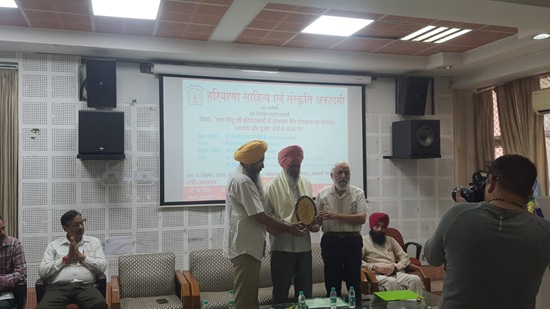
Chief guest Professor Kuldeep Chand Agnihotri, former Vice Chancellor, said in his address that India’s history is among the oldest in the world. He referred to the ancient civilisations of Mesopotamia and the Nile Valley and said that archaeological findings at Rakhigarhi point to a civilisation dating back thousands of years. He also referred to the Rig Veda’s references to the Sapta Sindhu region.
Agnihotri also criticised what he described as shortcomings in the way Indian history has been written, arguing that the contributions of people who resisted foreign powers have not received adequate attention.
Speaking at the symposium, Dr. Jagpal Singh said history requires deep reflection and noted that the tradition of historical writing had long focused primarily on the chronicles of kings. He said Karl Marx broadened the scope of historiography by drawing attention to the lives of ordinary people.
Dr. Jagpal Singh said Harbhajan Singh had documented the grassroots history of the Malwa region by travelling from village to village and drawing upon oral traditions. He said Selbarah’s work was not merely a record of events but also documented the social and cultural history of the region.
Dr. Jaswant Singh discussed Harbhajan Singh’s writings on village history in detail and presented an overview of his books.
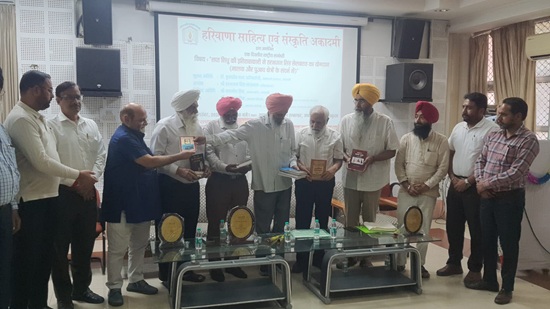
On the occasion, Babushahi.com Editor Baljeet Balli highlighted Harbhajan Singh’s 12 years of work and his research on the history of 284 villages in Bathinda district.
Balli praised the extensive research that went into the compilation of the work and said it was a matter of pride that a teacher from Bathinda district had undertaken research on the history of the Sapta Sindhu region on a scale that would otherwise require the efforts of an institution or government body.
Balli also expressed concern that while the Haryana Government had recognised Harbhajan Singh’s work, no academy or government institution in Punjab had so far formally recognised or honoured his contribution.
He suggested that the historical research compiled by Harbhajan Singh should be considered for inclusion in school and college curricula.
Harbhajan Singh is a retired teacher and a resident of Selbarah village in Bathinda district.
Dr. Devendra Kaur also spoke about the broader dimensions of historical writing. Harpal Singh, Director of the Punjabi Cell, expressed gratitude to Harbhajan Singh for undertaking the work of documenting history without seeking personal gain and said society remained indebted to such efforts.
Dr. Chittaranjan Dayal Singh Kaushal, Director of the Sanskrit Cell, and Manjit Singh, Member Secretary of the Akademi, also shared their views on the tradition of historical writing. The symposium was moderated by Dr. Vijendra Kumar.
Renowned historians and scholars, including Dr. M.M. Juneja, Balwan Singh, Rajiv Gupta, Dr. Ajayveer Singh, Manisha Nandal, Dr. Pratibha, Mukesh Lata, Anju Kakkar, Ritu, Pradeep Sharma, Dinesh Kumar, Om Prakash Singh and Dr. Jitendra Parwaz, among others, attended the symposium.