Mera Khazana | I Didn’t Just Watch Satluj—I Reported That Era…..by Baljit Balli
Questions Raised by Satluj?
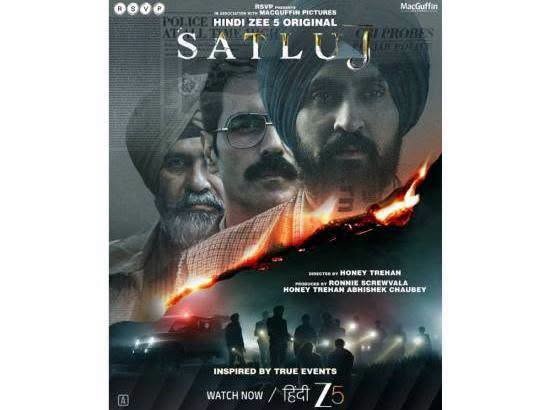
The removal of Satluj (formerly Punjab 95), the film inspired by the life of human rights activist Jaswant Singh Khalra, only two days after its OTT release, has reopened difficult questions about history, free expression, and how societies confront painful chapters of their past.
As someone who covered Punjab’s troubled years as a journalist, I watched the film not merely as a viewer but as a witness to many of the events it portrays. Along with fellow journalists of that era, I met Jaswant Singh Khalra and members of his team on several occasions.
I reported extensively on Khalra’s campaign to expose the mass cremation of unidentified bodies, closely followed the lengthy CBI investigation, and, for the Daily Ajit newspaper, conducted an exclusive interview at a secret location in Chandigarh with Kuldip Singh, a key eyewitness and Special Police Officer (SPO)*, while he was being sought by the Punjab Police. I also witnessed the long legal battle that unfolded over the years.
The film inevitably brings back memories of one of the darkest periods in Punjab’s history—a time when ordinary citizens were caught between armed militancy and police excesses and human rights violations, many of which were later investigated by the CBI and established through judicial proceedings, resulting in the conviction of several police officials. While no film can fully capture such a complex period, Satluj succeeds in presenting an important chapter of the life and sacrifice of Jaswant Singh Khalra.
Like every historical film, it is open to debate. Some may argue that it focuses primarily on one dimension of Punjab’s tragedy, while others may feel that it tells a story that deserved to be brought before a wider audience. Both viewpoints deserve to be heard.
Having personally reported many of the events depicted, I found the film remarkably close to the historical record. A few scenes understandably take cinematic liberties, but the broader narrative reflects incidents that many journalists, investigators, lawyers, and families of victims experienced firsthand.
The controversy surrounding the film’s withdrawal has now become larger than the film itself. It has reignited discussions about historical memory, artistic freedom, and the importance of allowing society to engage with difficult truths through literature, journalism, and cinema.
Whether one agrees with the film or not, history cannot be understood by silence alone. Democracies become stronger when they allow difficult conversations to take place.
I have written a detailed review and personal reflection, drawing upon my own reporting during those turbulent years.
— Baljit Balli
Editor-in-Chief, Babushahi News Network
July 07,2026
Know About SPOs
Special Police Officers (SPOs) were recruited in Punjab during the late 1980s and early 1990s as a temporary, locally recruited auxiliary force to support the police in combating militancy. They played a complex and highly controversial role during the peak of the Punjab insurgency, assisting regular police forces in localized policing, patrolling, intelligence gathering, and counter-insurgency operations.
The SPO programme, introduced under the leadership of former Punjab DGP K.P.S. Gill, attracted considerable criticism from human rights organizations and civil liberties groups. Because many SPOs operated with limited formal training and inadequate oversight, some were implicated in allegations of human rights violations, including extortion, enforced disappearances, and unlawful extrajudicial killings in so-called “fake encounters,” often alongside regular police personnel.
In later years, a large number of SPOs were absorbed into the Punjab Police as constables.
Full text of my article

Mera Khazana
Satluj, Jaswant Singh Khalra, and the Truth History Cannot Bury
Exactly what Diljit Dosanjh feared on the day Satluj began streaming on an OTT platform has ultimately happened. The film, based on the life of human rights activist Jaswant Singh Khalra, was uploaded on July 3 and taken down on July 5.
Everyone believes they know where the order to remove the film came from. But the more important questions remain unanswered: Why was it removed? Who exerted pressure? What reasons were given? Who stands to gain, and who loses from this decision? These questions continue to linger. Even earlier, the film had secured clearance for release only after its title was changed.
Ironically, the film was streaming on Zee5, a platform owned by a media group long regarded as being close to the ruling establishment. Those who ordered its removal may have had their reasons, but a large section of the film fraternity, Punjabis in India, and the global Punjabi community are unlikely to support this decision. For many Sikhs, it is likely to reinforce the perception that Punjab is subjected to a different set of standards than the rest of India.
Politically, it is worth recalling that when the events surrounding Khalra unfolded in 1995-96, the Congress was in power both at the Centre and in Punjab. Today, however, preventing the film from reaching audiences—and then removing it merely two days after its release—is likely to politically hurt the party currently governing at the Centre.
That perhaps explains why BJP Punjab President Kewal Dhillon appears uncomfortable with the controversy and has reportedly urged the Central Government to reverse the decision. Meanwhile, many viewers have already downloaded the film, making its wider circulation almost inevitable. Outside India, the film continues to face no such restrictions.
Diljit Dosanjh and the filmmakers came to Jaswant Singh Khalra’s story much later. I, however, along with fellow journalist Satinder Bains and many others who were actively reporting during those turbulent years, witnessed not only Khalra’s struggle but also his family’s ordeal, his campaign to secure justice for unidentified bodies, the prolonged CBI investigation, and countless other tragic events that marked Punjab’s years of militancy and counter-insurgency.
On that basis, I can confidently say that there is very little in the film that appears fictional or unfamiliar to those of us who covered those years firsthand. We documented those tragedies ourselves, filling thousands of newspaper and magazine pages while working under the constant shadow of police excesses and grave personal risk.
During a video discussion on July 6 with a senior journalist, he remarked that many of the alleged excesses attributed to then SSP Ajit Singh Sandhu were, in fact, not even depicted in the film.
I had watched the film before its official release. After viewing it, I noted down my impressions, which I now present in a revised form.
Watching the film inevitably takes people like me back to Punjab’s painful decade and a half—a period during which ordinary citizens were crushed between two grinding stones: armed Khalistani militancy on one side and what many described as State terror on the other.
Unidentified Bodies That Spoke From the Cremation Grounds
Satluj (formerly Punjab 95) revolves around the life and struggle of Jaswant Singh Khalra, who sacrificed his life while fighting for human rights.
The film portrays the then DGP K.P.S. Gill and Tarn Taran SSP Ajit Singh Sandhu, against whom allegations were levelled that Khalra was abducted, subjected to prolonged torture, and later killed, with his body allegedly disposed of in a river. Naturally, these three figures form the central axis of the narrative.
Produced by Ronnie Screwvala’s RSVP Movies and directed by Honey Trehan, the film realistically recreates the era of alleged fake police encounters, where young men and others were branded as terrorists, declared “unidentified,” and cremated without informing their families.
Equally important, the film depicts Khalra’s painstaking effort to collect records, documents, statistics, and evidence relating to these unidentified cremations, laying the foundation for one of India’s most significant human rights campaigns.
The Role of the CBI and the Courts
The film also portrays the atmosphere that prevailed during the latter part of the Beant Singh government’s tenure, highlighting allegations of police excesses, abuse of power, and human rights violations by senior officers.
Alongside the assassination of Chief Minister Beant Singh, the film reconstructs the alleged abduction and killing of Jaswant Singh Khalra and the subsequent attempt to conceal the crime by disposing of his body.
While the film presents the alleged excesses of the Punjab Police in disturbing detail, it portrays the Central Bureau of Investigation (CBI) quite differently. Led by Arjun Rampal’s character, the CBI team is shown conducting a sincere investigation into Khalra’s disappearance and the alleged illegal actions of police officials.
The film follows the process of gathering evidence, presenting it before the courts, and ultimately securing convictions against several police officials. At the same time, it notes that then DGP K.P.S. Gill—represented under a fictional name—was ultimately kept outside the scope of criminal liability.
Whatever the reasons, many human rights activists and lawyers continue to believe that in a large number of alleged fake encounter cases investigated by the CBI under court supervision, the evidence proved sufficiently strong to secure convictions, with legal proceedings continuing even today.
For many, these judicial outcomes helped restore some faith in India’s justice system, though the path to justice remained painfully long, dangerous, and emotionally exhausting for victims’ families and human rights defenders.
The Truth About an SSP’s Suicide
The film depicts several real-life personalities through fictional names, including former Chief Ministers Beant Singh and Harcharan Singh Brar, former DGP K.P.S. Gill, SSP Ajit Singh Sandhu, and several police officers accused in the Khalra case.
It also portrays attempts by Chief Minister Harcharan Singh Brar to impose greater accountability on the police and his opposition to extending K.P.S. Gill’s tenure.
The film includes scenes depicting the suicide of a police officer representing Ajit Singh Sandhu after becoming embroiled in multiple cases involving alleged fake encounters, land grabbing, and the Khalra investigation.
As someone who personally reported many of these events, I can say that while the film stays remarkably close to historical reality, a few details have understandably been altered for cinematic purposes.
For example, the film suggests that the officer’s face could not be identified after his death. That is not accurate. When the incident occurred near Dera Bassi in May 1997, I was working with Ajit newspaper. Our photographer T.S. Bedi and I were among the first journalists to reach the railway tracks where the body was found. We photographed the scene ourselves. His identity was unmistakable. I still remember seeing his severed body lying beside the tracks, wearing a gold wristwatch, a gold bracelet, and formal clothes.
The film also reminded me of an interview I conducted for Ajit with a key SPO KUldip Singh, an witness in the Khalra case, who at the time was living in hiding in Chandigarh. There are a few other minor factual deviations, but these are understandable within the demands of cinematic storytelling.
The scenes depicting custodial torture and police brutality are deeply disturbing. They leave viewers saddened, disturbed, and angry.
One of the film’s greatest strengths is its portrayal of Khalra’s wife, Paramjit Kaur Khalra, shown under a fictional name. Her courage and determination in carrying forward her husband’s mission have been portrayed with remarkable sensitivity. Not only journalists, but the entire Punjabi community has witnessed her extraordinary commitment.
The film does include references to Khalistani militant groups, their violence, and the justification offered by some police officers for their actions. Yet the performances, direction, make-up, and production design remain highly convincing, with little trace of artificiality.
Even so, survivors of that era, victims of militancy, and others who suffered at the hands of armed groups may legitimately argue that the film presents only one side of Punjab’s tragedy. That criticism is understandable. However, the filmmakers’ stated objective was always to focus on the life and work of Jaswant Singh Khalra. In fact, the film was originally titled after him before the title was changed to Punjab 95 following objections from the censor authorities.
At the same time, another question naturally arises. While the film powerfully depicts those who allegedly suffered at the hands of the State, it pays comparatively little attention to the thousands of civilians who were killed or victimised by Khalistani militant violence and whose human rights were equally violated.
The greatest tragedy of that period was that there was also a third category of victims—ordinary people from Punjab and neighbouring states who found themselves caught between the violence of both sides and suffered immensely.
July 7, 2026
-

-
Baljit Balli, Editor-in-Chief, Babushahi News Network
tirshinazar@gmail.com
Phone No. : +91-9915177722
Disclaimer : The opinions expressed within this article are the personal opinions of the writer/author. The facts and opinions appearing in the article do not reflect the views of Babushahi.com or Tirchhi Nazar Media. Babushahi.com or Tirchhi Nazar Media does not assume any responsibility or liability for the same.