By Amrit Pal Singh #Babushahi Network
Bathinda, September 22, 2026
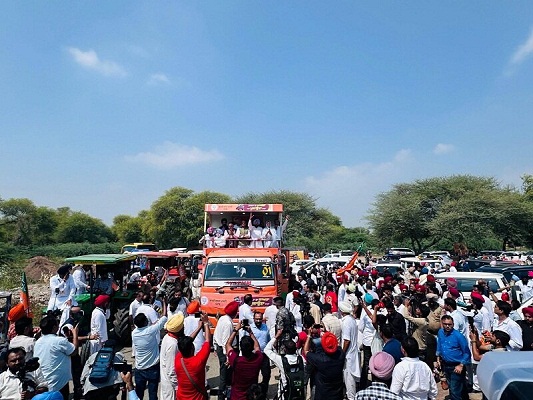
The BJP’s ‘Nasha Mukt Punjab Yatra’ has turned Bathinda into a significant stage for the party’s anti-drug campaign, bringing together senior national and state leaders, party workers and supporters while generating considerable discussion at the grassroots level.
The fourth leg of the BJP’s state-wide campaign was launched from Talwandi Sabo in Bathinda district, with Union Agriculture Minister Shivraj Singh Chouhan leading the programme. Chouhan publicly pledged that, if the BJP forms the government, the party would dismantle Punjab’s drug supply chain within six months, a political commitment that has placed the drug issue firmly at the centre of the campaign.
The scale of the mobilisation was significant. The BJP has planned four simultaneous yatras covering around 4,000 km and all 117 Assembly constituencies, culminating in Jalandhar on September 30. The party has described the campaign as a movement against drugs and a social initiative, while its timing and statewide political mobilisation have inevitably given it a wider electoral dimension.
National leadership descends on Punjab
The presence of senior BJP leaders has added considerable political weight to the campaign. Among those associated with the Punjab mobilisation are Shivraj Singh Chouhan, BJP National General Secretary and Punjab in-charge Satish Poonia, Punjab BJP president Kewal Singh Dhillon, former state president Sunil Jakhar, BJP National Vice-President Manpreet Singh Badal, Manthri Srinivasulu and State Media Co-incharge Parampal Kaur Sidhu.
The concentration of senior leadership in Punjab signals the importance the BJP is attaching to the state organisation and its grassroots mobilisation ahead of the 2027 Assembly elections. The party has publicly framed the campaign around the drug issue, while simultaneously using the yatra to establish contact with workers and voters across the state.
Village conversations add another layer
Beyond the political stage, the campaign has triggered discussions in villages and local gatherings. Residents have been debating the drug problem, its impact on families and young people, and the competing approaches of political parties towards tackling the menace.
The issue has already become a major point of political contestation in Punjab. The BJP has accused the AAP government of failing to meet earlier commitments on drugs, while AAP leaders have questioned the BJP’s record, including its period of alliance with the SAD. Recent reporting has described the drug issue as an increasingly prominent arena for BJP-AAP political confrontation.
The BJP, meanwhile, has repeatedly said that the yatra is intended to build a mass movement against drugs rather than function merely as a conventional political programme. Union Law Minister Arjun Meghwal similarly described the campaign as a social-reform initiative while speaking during the Punjab yatra.
Bathinda emerges as a key campaign theatre
The BJP’s choice of Talwandi Sabo for the fourth phase has given Bathinda district particular prominence in the state-wide exercise. It also comes shortly after a separate anti-drug youth mobilisation in Bathinda, where organisers said around 20,000 participants took part in a five-kilometre run promoting a drug-free society.
For the BJP, therefore, the Bathinda leg has combined three elements the anti-drug message, high-level leadership mobilisation and direct grassroots outreach.
The political significance of the campaign will ultimately depend on how effectively the BJP converts public discussion and worker enthusiasm into sustained organisational activity. For now, the yatra has succeeded in putting the drug issue back at the centre of political conversation in Bathinda—and ensuring that the BJP’s presence in Punjab is increasingly visible on the ground.
The larger political message
The campaign’s immediate message is centred on drugs, but its wider political messaging is difficult to miss. With the 2027 Assembly elections approaching, the BJP is using a statewide organisational exercise to take its leadership and campaign narrative directly to constituencies across Punjab.
Whether the drug issue remains the dominant electoral concern will depend on the wider campaign and the issues voters ultimately prioritise. But the Bathinda mobilisation demonstrates that the BJP intends to make drug eradication, grassroots outreach and organisational visibility prominent components of its Punjab campaign.