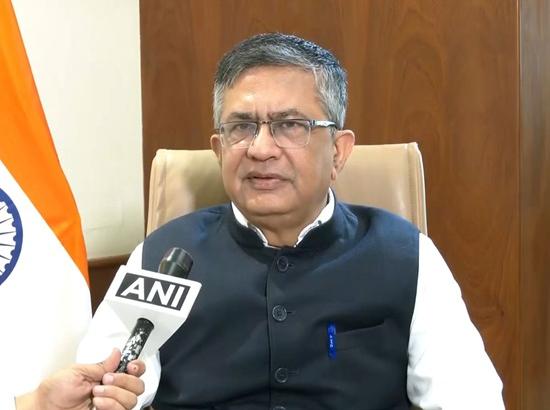
Photo Source: ANI
Foreign investors will return to Indian stock markets as India-US trade deal done: NSE MD
Mumbai (Maharashtra), February 3, 2026 (ANI): With the India-US trade deal announced, foreign institutional investors (FIIs) are expected to make a comeback in the Indian stock markets, as trade-related uncertainties ease and positive signals emerge from the agreement.
In an exclusive conversation with ANI, Ashish Chauhan, Managing Director and Chief Executive Officer of the National Stock Exchange, said that trade uncertainties were a major reason why FPIs remained cautious throughout 2025.
"Absolutely. One of the reasons why the FPIs have been holding back for the entire 2025 was largely due to the trade uncertainties, because it's not only the tariffs which matter, but also the signals that it gives, saying that India and the US were going apart. Now, this deal specifically puts both the countries together," Chauhan said.
Describing the agreement as a positive and long-awaited development, Chauhan said the deal came after almost a year of delay, despite being largely expected.
He noted that the United States is the largest economy in the world but remains highly dependent on imports, while India plays a crucial role in employment generation and sits at the top of the global technology pyramid, particularly in the IT sector.
"Kudos to Prime Minister Narendra Modi for holding up and also getting the best possible outcome for India," he said.
Highlighting trade numbers, Chauhan said that in 2024, bilateral trade between India and the US stood at around USD 210 billion. Of this, goods trade accounted for roughly USD 135 billion, while services contributed around USD 85 billion. He added that the figure should have increased further by now.
Beyond trade volumes, Chauhan pointed to the growing importance of Global Capability Centres (GCCs) of large US companies in India, saying this made it essential for India to have the US as a strong strategic partner. He said the industry and services sectors were delighted with the outcome of the deal.
On the energy front, Chauhan highlighted India's advantage in processing Venezuelan crude oil, which is among the most difficult types of crude to refine.
He explained that Indian refineries, designed to handle a wide variety of crude oils due to India's nearly 85 per cent dependence on imports, are well-equipped to process such heavy and sour crude. This capability has helped India emerge as the world's largest exporter of processed crude.
He further said that India and the US will continue to have complementary frameworks in technology, labour requirements and employment generation.
Bilateral deals such as this help India overcome disadvantages faced earlier under WTO rules, especially in labour-intensive sectors like garments, which were subjected to higher tariffs compared to peers.
Chauhan also noted that electronic exports to the US, including smartphones, have grown significantly, and with the US gradually moving away from China, India is well-positioned to emerge as a major global manufacturing hub going forward. (ANI)