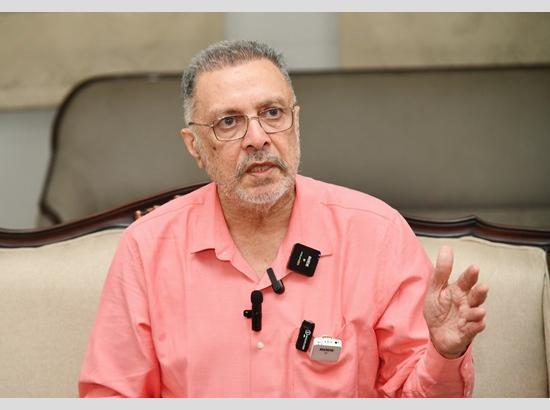
Photo Source: Babushahi Bureau
Punjab’s Mukh Mantri Sehat Yojna outpaces Centre’s Ayushman Bharat in coverage and per capita spending
Babushahi Bureau
Chandigarh, March 22, 2026 — As rising medical costs continue to strain household finances across India, a sharp contrast is emerging between the Centre’s Ayushman Bharat and Punjab’s Mukh Mantri Sehat Yojna in both funding and approach.
While the Central scheme allocates ₹9,500 crore for a population of nearly 140 crore, Punjab has committed ₹2,000 crore for around 3 crore residents in its 2026–27 Budget. The difference translates into a significantly higher per capita investment by the state, underscoring a stronger focus on accessible healthcare.
The divergence extends beyond funding into the design of the schemes. Ayushman Bharat provides health coverage of up to ₹5 lakh per family annually, but is restricted to beneficiaries identified through the SECC database. In contrast, Punjab’s Mukh Mantri Sehat Yojna offers ₹10 lakh cashless treatment per family and covers every resident of the state, regardless of income or eligibility criteria.
Under the leadership of Chief Minister Bhagwant Singh Mann, the Punjab Government has adopted a universal healthcare model, positioning medical access as a right rather than a targeted welfare benefit. The approach removes eligibility barriers, ensuring that treatment is based solely on medical need.
Healthcare access remains a critical concern for most families, especially during emergencies where both timely treatment and financial capacity become immediate challenges. Addressing these issues, the state scheme aims to provide seamless and cashless services to nearly 65 lakh families across Punjab.
Another key difference lies in the scope of treatment. The Punjab scheme covers around 2,300 treatment packages, including major illnesses such as heart disease, cancer, kidney disorders, orthopaedic procedures, and accident-related injuries. Ayushman Bharat, by comparison, includes approximately 1,900 packages.
The enrolment process also reflects contrasting approaches. Under Ayushman Bharat, beneficiaries must verify their inclusion in government databases and meet eligibility criteria. Punjab’s model simplifies access, allowing residents to enrol through Seva Kendras, Common Service Centres, or online platforms using basic identification such as Aadhaar or voter ID, without the need for income proof.
To expand outreach, the state has also initiated door-to-door registration drives, with trained youth volunteers assisting families in obtaining their Sehat Cards. So far, over 9 lakh cards have been issued, enabling beneficiaries to access treatment across a network of nearly 900 empanelled hospitals.
The impact of the scheme is already visible on the ground. In Moga, a 98-year-old woman, Mukhtiar Kaur, was able to receive specialised treatment, including chemotherapy-related care, fully covered under the programme—highlighting how timely access can reduce both financial and emotional strain.
Punjab Health Minister Dr. Balbir Singh said the initiative reflects a deliberate policy shift. He emphasised that the scheme is designed to ensure healthcare reaches every resident, moving beyond selective coverage to a more inclusive framework.
As healthcare costs continue to rise, the contrast between the two models highlights a broader policy debate—whether healthcare should remain a targeted benefit or evolve into a universal public right. Punjab’s approach signals a move towards the latter, placing accessibility and equity at the centre of its healthcare strategy.